
Creativity and Neuroscience
The Science behind Creativity
Chinese brush painting is good for you!
The connection between creativity and our mental health is talked about more freely these days, but it is definitely not a modern trend or fad we should dismiss, just because the term “Well-being” has become ubiquitous and marketable. The origins of using art as a therapeutic tool date back to ancient Egypt, where dancing was prescribed for mental disorders. In ancient Greece and Rome, art and culture were appreciated for their “catharsis” effect; even then, people knew that releasing repressed emotions through the Arts was beneficial for their mental and physical health. The therapeutic effects of creating (in whatever form: art, music, performance) has gained scientific acceptance since the early 1960s, thanks to some key research and writings by Margaret Naumberg1 in the United States. In the UK, Adrian Hill coined the term “art therapy” in 1942 and wrote a book entitled Art versus Illness2. What these writings, and several scientific-based studies, show is that creating art can significantly reduce depression, anxiety, and the way they manifest physically in the body.
But how? What is happening in our brains when we create art? How can art change the way we feel?
Neuroscience is a fascinating but complex multidisciplinary field of study. During the hot summer of 2025 I spent several months working through an online, certificated course in art therapy. I made copious notes and passed the final exam. A summary of the ideas I learnt whilst doing the course are what I am presenting to you in a very brief, summarised form. I am not an art therapist per se, which requires several years of devoted study at Masters level, but I am a practitioner who incorporates mindful techniques into my teaching and who now appreciates the extraordinary power of the brain and how we can train it to make us feel better.
The posh word for the brain’s cleverness at adapting itself in response to new experiences and learning is neuroplasticity. It’s a fundamental aspect of brain function and plays a crucial role in learning, memory, and recovery from brain injury. It’s also a key term for describing how we can select activities that target specific regions of the brain to regulate and ultimately change our thinking and behaviour!
It can be hard to imagine that we could in fact have direct control of our mood in this way. Inside our brains, clever neurotransmitters act as messengers taking signals between cells in the brain (neurons) and our whole nervous system. These messenger molecules regulate our brain function and behaviour.
There are several types of neurotransmitters and they are responsible for different responses:
- Dopamine regulates mood, attention, and experience of pleasure;
- Serotonin regulates impulse control, aggression, emotional regulation;
- GABA keeps neuronal activity in balance, regulates anxiety, relaxation and sleep;
- Glutamate is the main excitatory neurotransmitter in the brain and plays a critical role in learning and memory;
- Acetylcholine is responsible for attention, learning, memory and motor control, as well as regulation of sleep and arousal;
- Oxytocin regulates stress and anxiety, social bonding and trust.
These neurotransmitters working together keep us balanced and ensure we respond to impulses correctly. For example, if our hand accidentally comes into contact with a naked flame, the neurons send signals using the neurotransmitters, which ensures an immediate physical response of snatching the hand away. Years of research into the workings of the brain have brought us to the realisation that an intentional positive action (i.e. a creative activity) will also trigger and exercise neurotransmitters to regulate and improve our mood and behaviour.
Besides neurotransmitters, our emotions are generated and regulated by distinct regions in the brain. The regions to be especially aware of for emotional processing are:
Prefrontal Cortex (sits at the very front of the frontal lobe, directly behind the forehead) – its role is self-regulation, introspection (self-awareness), decision-making and problem-solving;
Amygdala (sits within the prefrontal cortex) – responsible for fear response and memory formation. It has the ability to inhibit or override emotional responses;
Insula (sits deep inside the brain) – a key area for emotional processing and interoception (the body’s own internal sensory system that lets us feel and understand what’s happening inside us i.e. hunger, thirst, heart rate, breathing. It helps you connect physical sensations to emotions like anxiety or tiredness);
Hypothalamus (sits at the base of the brain and above the pituitary gland) – its role is the regulation of mood, fear and aggression;
Hippocampus (positioned in the inner part of the temporal globe, on the sides of the head above the ears) – forms new memories, consolidates memories of facts and events from short-term to long-term storage. This part of the brain works with the amygdala in linking emotions to memories.
In a nutshell, what scientists now know is that creative activities trigger the same parts of the brain that look after our emotions. By activating these brain regions regularly, we are helping to strengthen positive neural pathways. In practical terms, don’t wait to feel depressed before picking up a paint brush or colouring pencils – do it when you’re feeling fine, in the knowledge that you are exercising important areas of your brain and keeping them strong and balanced. Art is both prevention and cure.
We hear a lot about “mindfulness” in relation to Well-being. What is it, and how does it sit with what I’ve written above about creativity and neuroscience?
Mindfulness is the practice of paying full attention to the present moment, focusing on our thoughts, feelings, body sensations and surroundings. It’s a cultivated skill that discourages dwelling on the past or worrying about the future. Mindfulness is a stress-busting technique.
Some ways to cultivate mindfulness are through focused breathing, sensory awareness, noticing without judging, and accepting things as they are without feeling the need to suppress or change feelings. Some creative activities that have been shown to promote mindfulness are drawing repetitive patterns (zen doodling) or colouring mandalas. These activities are helpful because they are stimulating those regulatory parts of the brain that I spoke of earlier.
Why Chinese Brush Painting is Good for You
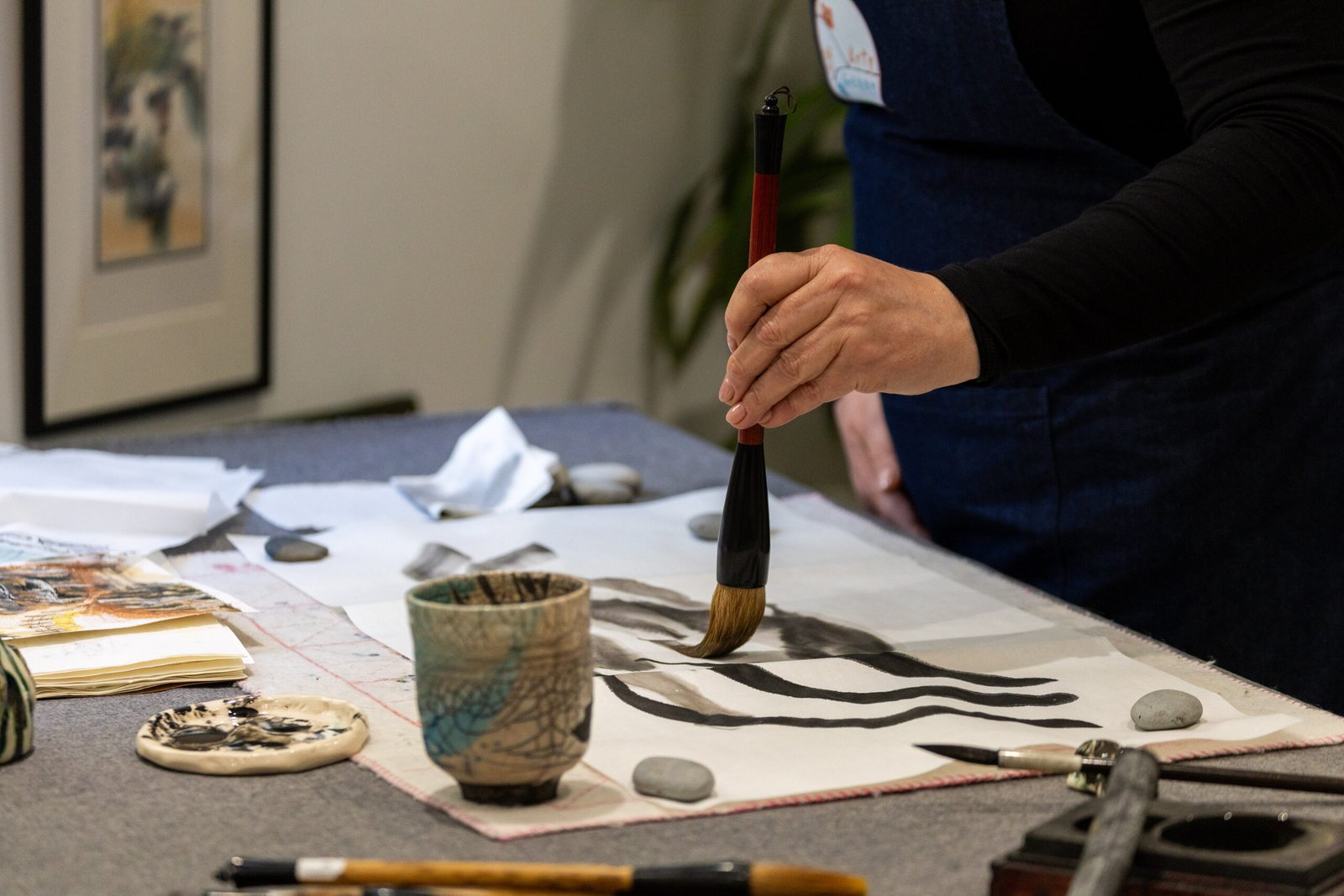
Chinese brush painting cultivates mindfulness. It does so in the following ways:
- The brush strokes require patience and focus;
- Repetition of the strokes builds skill in the art but also calms us;
- Painting the strokes requires deftness, but the mindset is slow and reflective;
- Learning to balance the ratio of ink to water on the brush is key to “controlling” the outcomes as we paint on unpredictable unsized paper, but we learn to accept the unplanned surprises and see them as part of the beauty in Chinese brush painting;
- We learn to leave perfectionism behind and embrace the character and uniqueness of our Chinese brush paintings;
- Posture and breathing are important aspects of Asian ink art.
A Happy Person is a Well Person
A workshop in Chinese brush painting teaches you a new way to approach art; you learn to appreciate concepts of space, composition and energy. What is more, you are also looking after your emotional health; enjoying the company of others, acquiring a gentle focus and seeing your skills improve, taking part without putting pressure on yourself to be “good” all activate the parts of your brain responsible for a sustained good mood!
If you’d like to try Chinese brush painting, why not visit my WORKSHOPS page for details about bespoke sessions in my Dorset studio? I also run group workshops in other Dorset venues which are listed under EVENTS.
SOURCES:
- Naumberg, M., (1987). Dynamically Orientated Art Therapy: Its Principles and Practice, illustrated with three case studies. Chicago: Magnolia Street Publishers
- Hill, A. K. G., (1945). Art versus illness. London: G Allen & Unwin