
What are the Origins of Chinese Brush Painting?
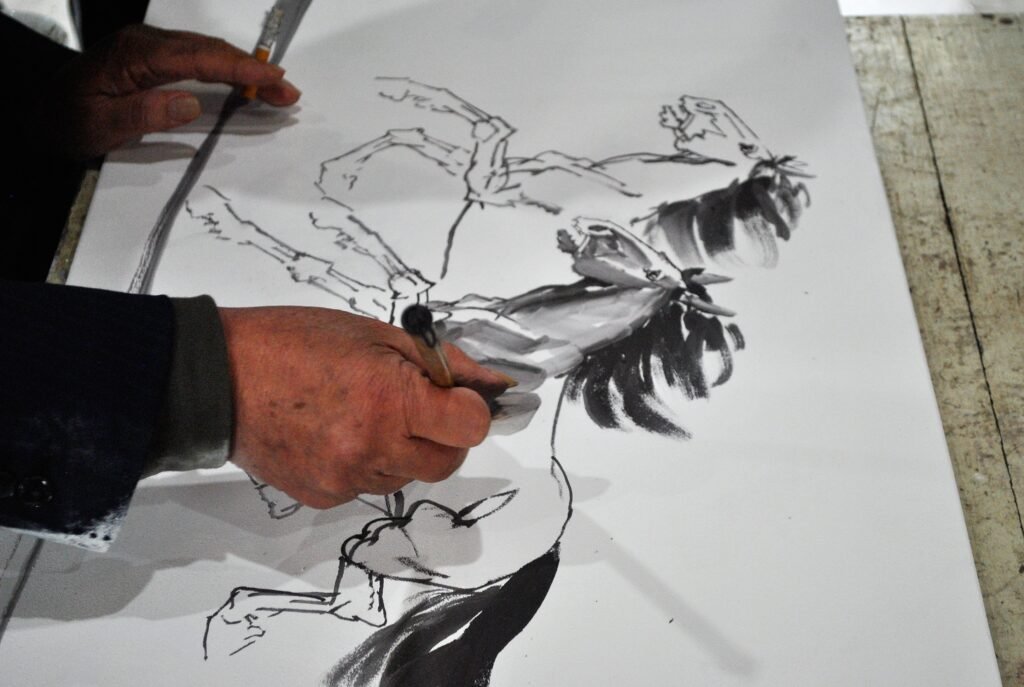
What are the Origins of Chinese Brush Painting?
A Brief Overview of an Art Technique with Ancient Roots.
“Real knowledge is to know the extent of one’s ignorance”
Confucius
It’s true to say that China’s history has been turbulent, but – apart from the years of the Cultural Revolution under the leadership of Mao Zedong 毛泽东 from 1966 until his death in 1976, when traditional Chinese painting was repressed, art schools closed, and paintings destroyed – the practice of Chinese fine art today remains loyal to its traditional roots, and those roots go deep!
Alongside the more immediate challenge of controlling the ratio of ink to water on my Chinese brush, I have managed to absorb a certain amount of knowledge in the past few years about the history of Chinese brush painting. This short article is simply intended to provide some historical scenery to entertain you as you embark on your painting journey. It’s a summary of facts gathered from many different sources and I have referenced as many of them as I can.
The beginnings of Chinese brush painting date to the Warring States Period (475 BCE – 221 BCE) during the Zhou dynasty. For China it was a time of intense conflict and philosophical development. In comparison, Britains at this time were living in the Iron Age within various Celtic tribal communities, and they were starting to flourish in early versions of “towns”. We’re talking of a time that pre-dates the Roman invasion.
Meanwhile, during the Warring States Period in China, the teachings of Confucius (551 – 479 BCE) were influential in seeking solutions to the chaos that reigned. His ideals for society became the backbone of China’s identity and still shape families’ moral code today. Chinese artists at this time simply recorded important social and religious events in their painting on silk using rabbit hair brushes. It could be said that the human figure was the first “genre” of Chinese brush painting.
The Tang dynasty (618 – 907 CE) was considered a golden age in Chinese civilization. Chinese artists mastered new sophisticated brush techniques due largely to the interest and support provided by the Tang imperial court. Court painters were given leave to devote their time and energy to painting and experimenting with forms and styles. The Tang court artists played a key role in defining female beauty in their paintings of court ladies.
By the era of the Five Dynasties (907 – 960 CE) the favoured genre was flowers and birds. The subsequent Song dynasty (960 – 1279 CE) was an important era for Chinese brush painting, due to the influence of emperor Huizong. Located in the north of China, he set up the Imperial Academy of Painting and promoted a meticulous realistic style of landscape painting on silk. Court artists were encouraged to copy old masters and stick to the “house style”.
Paper wasn’t invented until around 105 CE. It occurred during the Han Dynasty (206 BCE – 206 CE) by a court official called Cai Lun. His invention became the process that was eventually adopted by Spain under Moorish rule in the 12th century CE (the first mill was established near Valencia around 1144), followed by the rest of Europe.
The invention of paper ultimately enabled artists to develop their painting skills but it was a long and gradual process for paper to replace silk as the painting surface for Chinese brush artists. During the Tang dynasty (618-907 CE) through to the early Song dynasty, the production of paper was significantly improved and Xuan paper became a cheaper and preferred option for artists, especially those away from the authority of the imperial court.
These breakaway artists in the south were the “Literati” painters. The Song dynasty saw the southern artists reject the painting traditions dictated by the northern imperial court. They favoured self-expression in painting; they painted on unsized Xuan paper and focused on capturing the spirit or emotion of a scene with deft motions of the brush. This style of painting is still popular today and is known as Xiěyì 写意 (loosely translated as “writing ideas”). Emperor Huizong’s favoured meticulous method of painting, in contrast, is known as gōngbĭ 工笔.
Landscapes were not a recognised genre of Chinese brush painting to begin with. They were initially treated as mere backdrops to court scenes, until the influence of Daoism in China during the Tang dynasty (618 – 907 CE) led artists to find solace in nature away from the struggles of life. Landscapes henceforth became a prestigious genre in Chinese brush painting; compositions included space for heavenly as well as earthly elements. Landscape painting is said to have reached its pinnacle during the Song dynasty, with mountain peaks a key element. Under Emperor Huizong’s influence, landscapes were painted with order and precision, whereas the southern literati artists looked for the spirit in landscape, with old trees and rocks as important motifs.
In Ming dynasty China (1368 – 1644) – equivalent to the Tudor era in the UK – artists either had professional status with a sponsor, or were artist scholars. The former used realism in their approach to Chinese brush painting, and the latter relied on self-expression. The Wu School of scholar (literati) artists favoured self-expression over realism, and paintings incorporated rich colours. In the Qing dynasty, paintings by artists of the Shanghai School were characterised by bold, expressive ink outlines using “the bone technique”. Artists were sketching more loosely with their brushes.
Since being labelled as a “Black Art” during the Cultural Revolution, Chinese brush painting has now regained respect throughout East Asia and beyond. Japanese artists, who call it Sumi-e, have adopted Chinese brush techniques but developed their own particular monochromatic style. Contemporary Chinese artists experiment but always with a nod to the past, and some are incorporating Western composition and ideas into their paintings.
The character for “paint” in the Chinese language is huā 画 and represents someone using a brush to mark the territories of a field. It is mark-making that defines Asian ink artwork (Chinese and Japanese artists alike) – due in part to its strong link with calligraphy – whereas in the western tradition artists have focused on painting mass, light and shade.
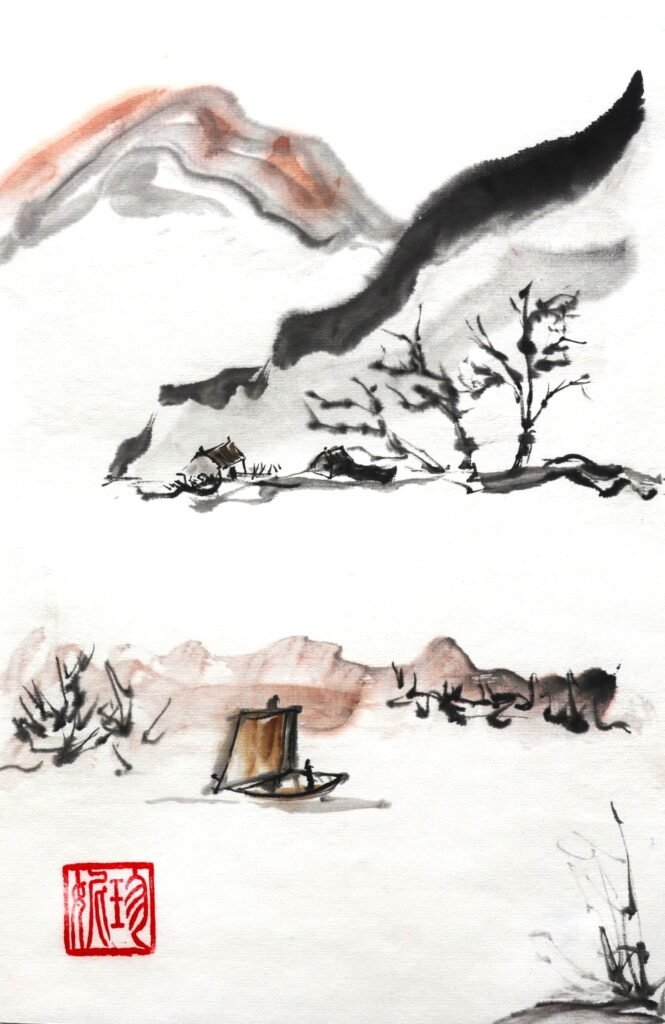
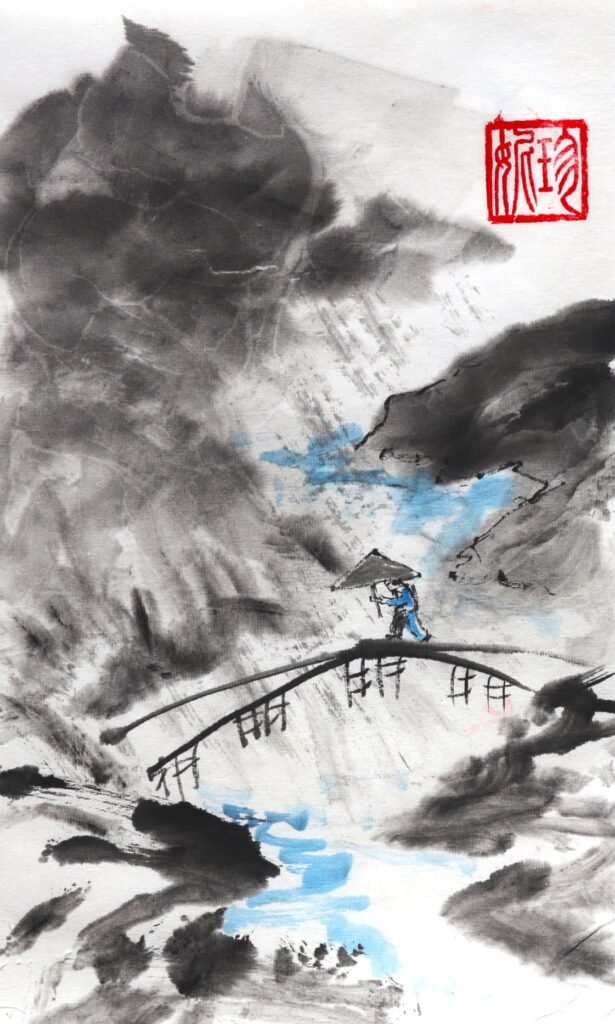
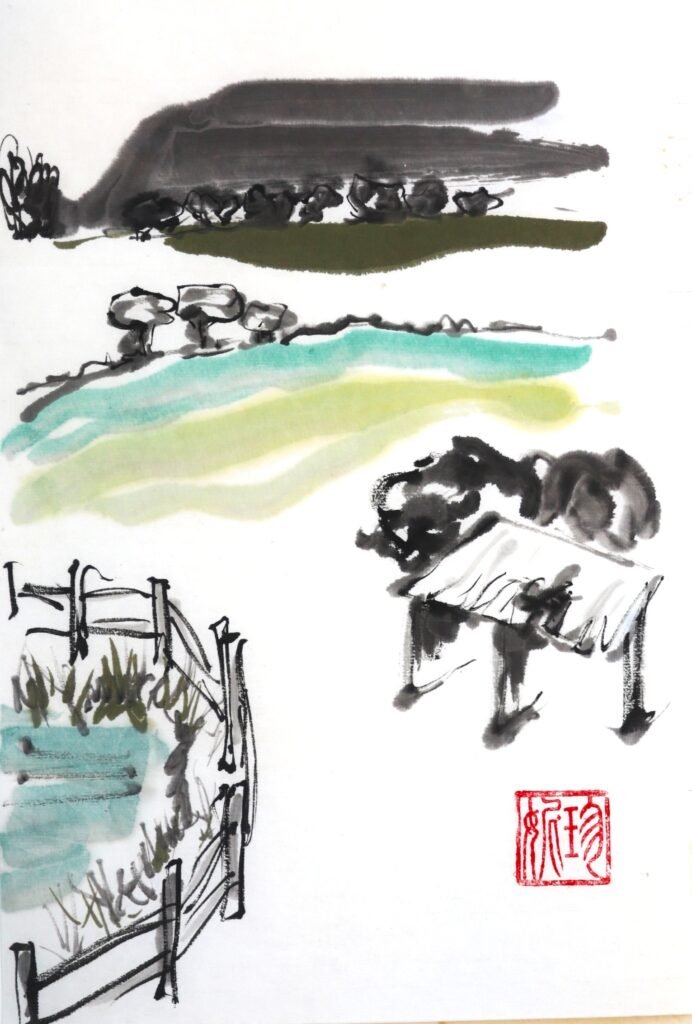
When I travelled to Shanghai in May 2019 it was principally to have lessons with a Chinese artist over five intensive days. The rest of my three-week stay centred around almost daily trips on the underground to Shanghai Museum. Here I wandered through the various galleries and admired the beauty of Chinese ceramics, bronzes, carved jade, and paintings. In the Painting Gallery especially I was intrigued and awed by the brush skills of those past Chinese artists. I was very aware of the contrast between their art and ours in the West. I spent time observing the paintings with a critical eye: space, composition and subject-matter struck me above all as being so quintessentially different to European art, but I also left Shanghai knowing that the love of nature is something that all artists on all side of the globe continue to share.
Here are some books in my possession that provide informative sections on the history of Chinese brush painting:
Hakuho Hirayama, (1986). Sumi-e Just for You. Barcelona: Parramón Ediciones, S.A.
Heizlar, J., (1987). Chinese Watercolours. London: Galley Press in association with Octopus Books Ltd.
Wu Yangmu, (1990). The Techniques of Chinese Painting. London: The Herbert Press Ltd.
Cherrett, P., (2003). The Practical Art of Chinese Brush Painting. Leicester: D&S Books Ltd
Von Spee, C., (2012). Modern Chinese Ink Paintings. London: The British Museum Press.